My Watches Twin
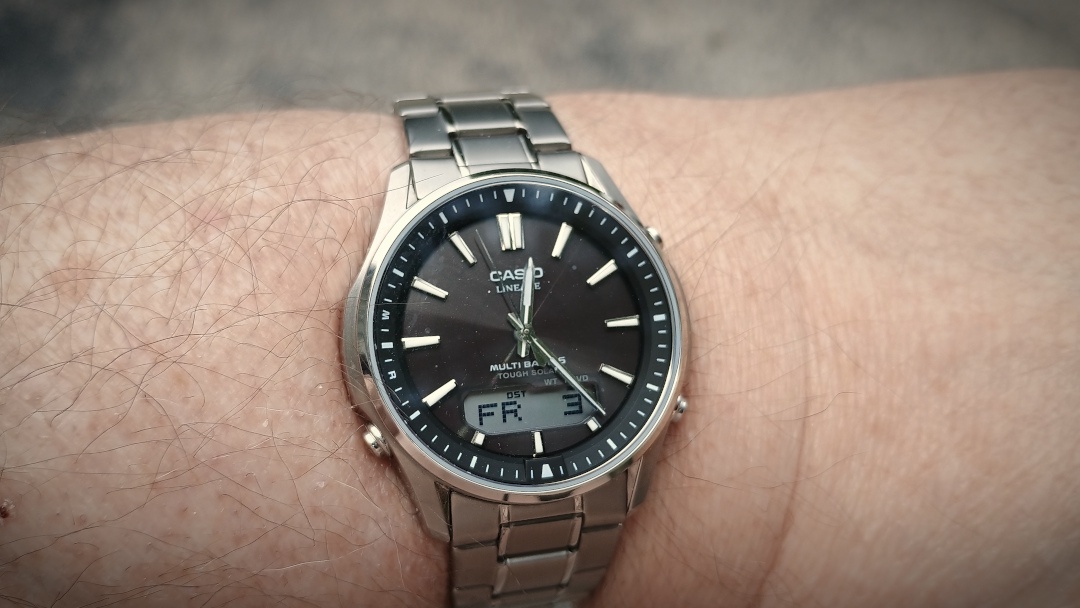 Casio Lineage LCW-M100TSE, Photo by Unattributed, License: Creative Commons BY-NC-SA 4.0
Introduction: The Casio Lineage LCW-M100TSE
The Casio Lineage watch line is in my top five daily wear watches. They represented one of the best values in watches imaginable at the price I paid: $180 USD. Today, unfortunately, due to changes in our import policies, they sell for around $250-$300 USD. That's still a reasonable price in my opinion given all the features this watch packs: titanium case and bracelet, solar-powered, dual time zones, up to five alarms, stopwatch, count-down timer, automatic DST/ST detection, and MultiBand 6. It's a lot of watch for the money, rivaled only by some of Casio's digital models.
One of the most amazing things about this watch is MultiBand 6, which automatically syncs the time to the radio broadcast Atomic Clock signals every day. But, even without the automatic synchronization it's accuracy is around ±15 seconds per month, that's under ±1 second per day. MultiBand 6 synchronization is set up by setting your home location in the watch. Once you've set up your home location, the watch will synchronize with the Atomic clock daily. This basically is the king of “grab-n-go” daily wear watches.
But, that doesn't mean it's perfect. The clasp is pressed steel. And the clasp only has two levels of adjustment, meaning that you'll likely have to remove links to resize the bracelet for your wrist. (Even with my 8.5 inch (ca. 22 cm) wrists I had to remove links.) Lume isn't spectacular, while it works, don't rely on it lasting more than a few minutes. The backlight, while bright, doesn't perform all that well. And water resistance is only 5 BAR (50 meters). The biggest problem, however, is availability. A quick scan of eBay shows only one of these watches available in North America, with a price tag of $290.
Enter the Twin
And there is one other thing: this may be a bit too fancy for some people to wear on a daily basis. Well, that's where the Lineage's sportier twin comes into the picture:
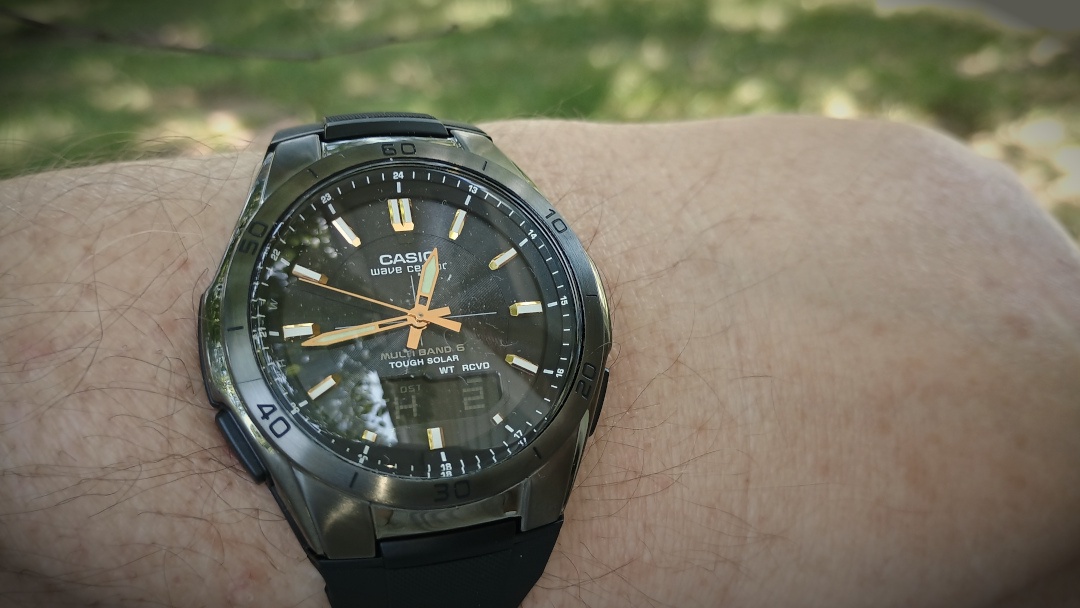 Casio Wave Ceptor WVA-M640B, Photo by Unattributed, License: Creative Commons BY-NC-SA 4.0
While it's not apparent just from looking at it, the Wave Ceptor uses the exact same module as the Lineage watch. This means all the features, such as solar-powered, dual time zones, up to five alarms, stopwatch, count-down timer, automatic DST/ST detection, and MultiBand 6 are the same as the Lineage. Where the differences come into play is on the exterior.
Instead of a titanium case and bracelet, the Wave Ceptor has a resin band. The case / bezel is stainless steel, and the crystal is a curved resin. The markers and hands are wider for easier visibility and to accommodate more lume. (Personally, I really like the markers on this watch better than the Lineage version.) They are also gold, which contrasts nicer with the black dial. The LCD on this version is in a negative configuration to make it blend with the rest of the watch face. This watch also features 10 BAR water resistance, making it more appropriate for an active lifestyle.
But, this watch hides a bit of a secret that makes it more interesting. Instead of a traditional resin strap, this one is integrated into the design of the case:
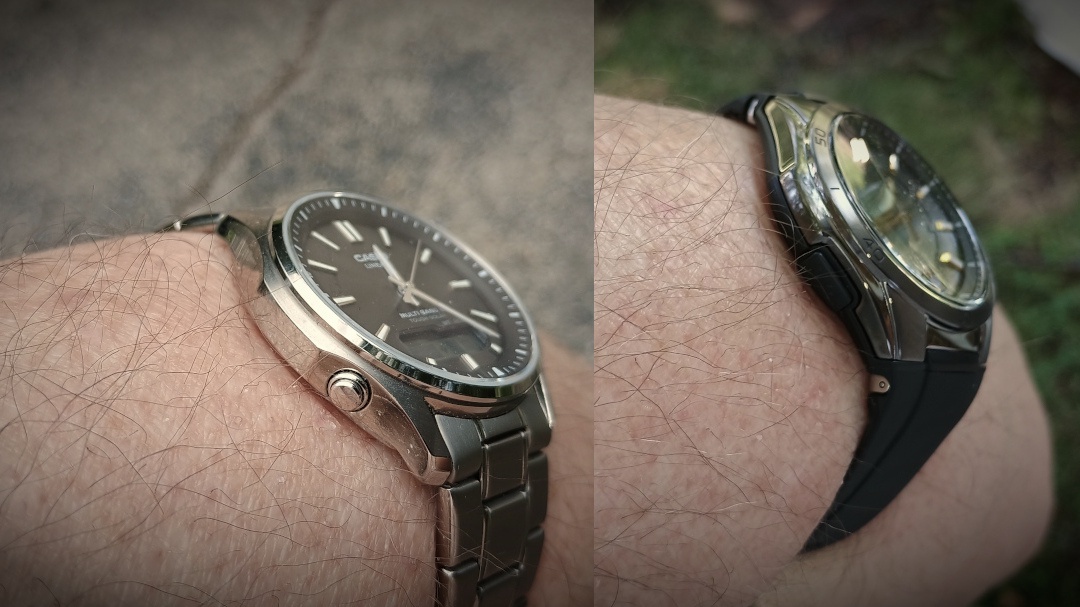 Lineage vs. Wave Ceptor, Photo by Unattributed, License: Creative Commons BY-NC-SA 4.0
The way the band is integrated into the case design gives it one additional property: shock absorption. Similar to the way G-Shock watch bands are curved to act like a spring, so is the Wave Ceptor. While the documentation doesn't mention how much shock protection is offered, it's clear that this watch was meant to fall somewhere between the Pro Trek and G-Shock lines of watches. Alas, this means changing to an alternative watch band is probably a bit more complicated than most watches (but, admittedly, I haven't tried to change the band on my watch).
But, the really nice part about this watch is the price: $150 USD. Basically half of what a Lineage watch costs. Why the difference? My guess is it comes down to the titanium and sapphire crystal, and the fact that the Lineage watch had to be imported. The difference in price before the current tariffs had gone into effect would have only been about $50.
Which Would I Choose? What Should You Choose?
I appreciate what the Wave Ceptor brings to the table. It's a great design for a person living an active lifestyle, especially if you don't have a need for a more dress-style watch. However, the Lineage is my ride-or-die. The titanium and sapphire crystal fit me better. However, I would recommend the Wave Ceptor over the Lineage to most people. Why? Simply the price difference. I cannot in good faith recommend a watch that is nearly double the price just for titanium and a sapphire crystal. And, especially for people in the United States, there appear to be more Wave Ceptors on the market than Lineage. Most of the Lineage watches have to be imported, and that might incur even more duties.
However, there is a small twist to this story. As I was researching these watches I learned that a lot of the Wave Ceptors from around the time of the WVA-M640B are no longer in production. They were discontinued in 2019, making it likely you will either have to turn to the secondary market, or find a new old stock, if you are lucky.
The Lineage line appears to have been around for a very long time. Many of the models I looked at had been refreshed / updated in 2024. Be careful if you are considering an older model as there is a chance that it won't be able to sync with the Atomic clock in North America. Instead, you may need to use an iOS or Android App to get it to sync. In my opinion—that's a nonstarter. I have wristwatches precisely because I want to break the dependence between my devices. It's the reason I don't have an Apple Watch or a Galaxy Watch.
Final Thoughts
There are a lot of Wave Ceptor and Lineage watches on the secondary market. It pays to do some research to know what you are getting before you purchase. The smart way to start is by looking up the module number for the watch you are considering. The module is what determines what features are included in the watch. By knowing the module number, you can generally find the documentation for the watch online. The watches I have all have module 5161, that is one of the things that I look for when buying a Lineage watch.
Another thing you can do (although I haven't found this to be completely reliable) is try decoding the serial number of the watch you are looking at. (If you can get the serial number.) This can tell you exactly when the watch was manufactured, which will tell you things like what version of MultiBand it has, which can then be used to determine if it will sync with the Atomic clock in your region.
Categories: #Review Tags: #wristwatches, #lineage, #waveceptor, #casio, #titanium, #sapphier, #resin License: Copyright Unattributed. Licensed under Creative Commons BY-NC-SA 4.0.
| FediRing | ||
|---|---|---|
| ◀️ Prev | Home | Next ▶️ |